Alopecia trial results
A combination formulation, two tested concentrations and a result with a curious ordering.
The combination tested
A 6-month trial in 45 men with androgenetic alopecia tested a topical complex of 5-aminolevulinic acid and glycyl-histidyl-lysine peptide. Androgenetic alopecia is pattern hair loss. The study reported statistically significant hair-count increases against placebo. The preparation contained a combination, and that gives the result its identity.
I’m pleased to encounter an actual human hair count after the cell experiments. It brings the subject back to an observable feature. Awarding the whole outcome to GHK alone would leave me arguing beyond the combination that was tested.
The chemical pairing deserves curiosity in its own right. Pulling it apart would lose the experiment’s subject. The trial’s visible subject is hair, and its experimental subject is a particular formulation.
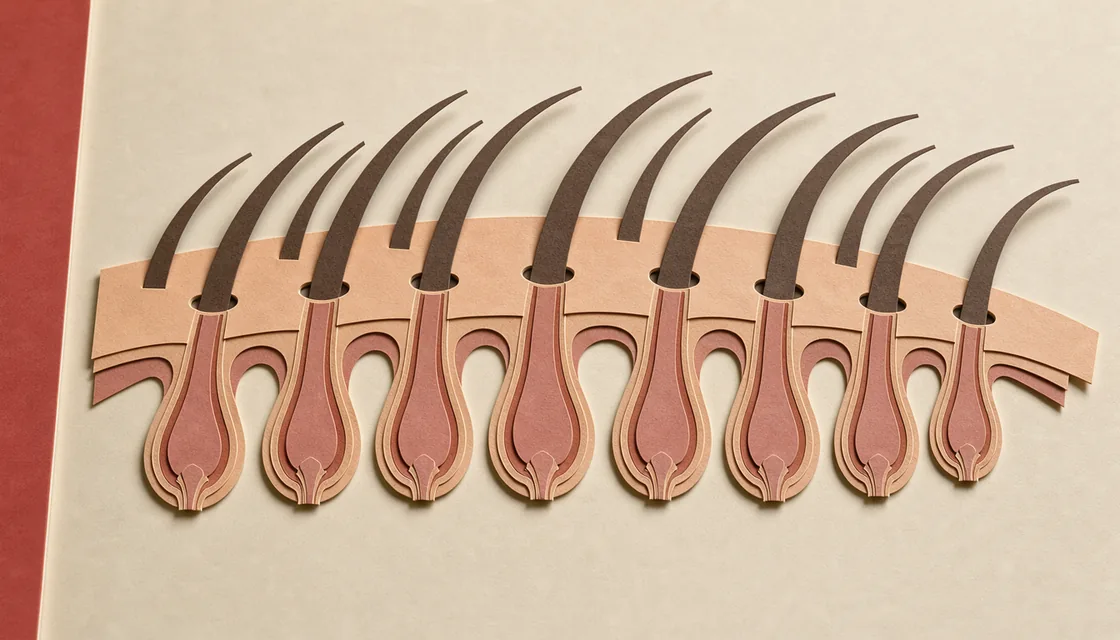
The two concentrations
The reported hair-count increase was 52.6 with the 100 mg/mL study formulation and 71.5 with the 50 mg/mL formulation, compared with 9.6 for placebo. These were concentrations tested in this trial, not a suggested treatment strength. The lower-concentration arm had the larger reported change.
That ordering is the small surprise I enjoy here. It interrupts the instinct to assume that a stronger preparation necessarily produces a greater response. The trial gives this particular ordering; it leaves the explanation and its reproducibility as further questions. An optimal concentration would be a much larger claim than I’m ready to make from these figures.
The numbers are changes in hair count, without a percentage sign. That is another useful distinction from the procollagen response percentages, which count the share of subjects showing a response.
Adverse-event reporting
The trial reported no adverse events in any group. That observation deserves space alongside the efficacy result. It describes what was reported in this study of these men over its follow-up.
I welcome the tolerability observation without treating it as a lifetime guarantee for the formulation or a safety result for other ways of administering GHK. The tested combination and its measured change are enough to occupy me. I’d trade another sweeping hair-growth claim for a larger repeat of this particular comparison.